Unpacking the Complexity of Command in Firefighting: A Reflection on Training, Experience, and Decision-Making
by Chief Glenn Usdin, former Chief, Lancaster Township, PA
“Command. School.” The words seem innocent enough. Who needs it? Who wants it? Why does it make a difference?
I’ve been handed an amazing opportunity by the editor of the PENNSYLVANIA FIREMAN to share my perspectives on the command aspects of firefighting. I guarantee that I will entertain some, piss off others, be accused of total blasphemy and far worse than I can print here. There are no absolute answers to most of the topics we’ll discuss.
For introduction, I started in the fire service 50 years ago on July 1st, 1974 as a member of the Massapequa FD on Long Island, just east of New York City. We were (and they still are) a very busy suburban volunteer department protecting around 90,000 folks on the South Shore of Long Island. Back in the 70’s and 80’s we went to a lot of fires, mainly residential and light commercial. Back in that era, when you came out of your house, it was not a rare sight to see a column of smoke or smell wood burning before you got to the firehouse. You got a job. Boots pulled up, coats closed, ear flaps down. Going to work.
Putting out fires is fun. It’s terrible that someone’s home or business is burning up. As long as you didn’t start the fire, do what you are trained to do. There is no greater feeling than knowing that you and your crew stopped a fire. Nobody joins the fire service to NOT put out fires. You’ve accomplished something too few ever get to do. My old friend from Massapequa Tom became an Air Force instructor pilot. He flew and taught pilots how to fly fighter jets for 30 years. Today he told me that putting out fires was the most fun thing he ever did. Better than flying A-10 jets a few feet above the ground. We’re cool.
Many of our members were also career FDNY firefighters, and much of Long Island fights fires in the manner and style of FDNY. When I joined, there were many World War II and Korea and Vietnam era military veterans in our ranks. It was constantly impressed upon us that we were a para-military organization, and leadership and chain of command were paramount in our mode of operation.
Our handlines were either 1.5 or 2.5” hose and we supplied the engines with 3” line. All of the trucks were straight aerials, before tower ladders came into use. We kept the SCBA in cases on the rig, and often we tried to get inside without a mask while the rest of the crew was unpacking the masks.
In 1989 I moved from NY to Lancaster Township PA to bring my used fire apparatus company to the Commonwealth. Within days of moving here, I joined a local fire company and weeks later, at a working motel fire in our first due area, I saw a ladder tuck operating. Upon finding out the truck company was actually first due at my home; I joined that company and eventually became the first fire chief of the newly formed Lancaster Township FD. Our response area ranges from million-dollar mansions to densely populated garden apartments into a very rural section with no hydrants. While not as busy as my Long Island company, our county’s mutual aid system keeps us moving around and going to a fair amount of work.
In the late 1990’s I became a devoted student of Chief Alan Brunacini and the Phoenix Fire Department. The PFD hosted an annual conference named the Incident Management Symposium. One afternoon I approached Bruno and introduced myself. Within minutes our shared love of Mack fire apparatus became apparent. I was honored to know Bruno for many years.
Bruno was one of the smartest men in the fire service. Being in his presence reminded me of what it would have been to know Ben Frankin. An astute student of the service, he attended OSU to get a degree in fire service protection. In the 1960’s and 70’s, our country faced many huge wildland fires that involved hundreds of homes built on what had once been undeveloped land. These fires were so massive that a system of managing operations for these was developed.
Bruno realized that much of what had been developed for wildfire operations was instantly applicable to the municipal fire service. Almost every weekend for almost 40 years Bruno and his assistant chiefs traveled the US teaching the newly developed Fireground Command System. The Federal Government eventually got involved and they developed a similar program, IMS (Incident Management System).
One day I approached Bruno and asked if he was interested in taking the Incident Management Symposium on the road around the USA. He smiled and said, “No, I can’t do that, but if YOU do it, I’ll come and teach!” I started Command School that day, and for 8 years we brought a bunch of highly skilled fire service leaders to 8 different locations around the country. The 3-day class included tabletop exercises, reviews of major fire incidents, and a wealth of shared experiences and techniques.
There was one focus of Command School, teaching the next generation of fire service officers how to run command.
I have spent thousands of hours watching and photographing fires on Long Island, the five boros of NYC and here in PA. I became fascinated with the differences between fires. Some went out almost instantly. Crews arrived, a magical man (always a man in the 70’s) in the front yard talking into his handie-talkie radio and with apparently little confusion or stress, the fire went out. Crews came out, did a handshake or nod, packed up and went home.
Then… well there were the other jobs. You could hear the screaming on the radio as you approached. The smoke got darker and darker. Windows that were clear suddenly turned dark and then flames shattered the glass. Evacuation horns sounded, the fire went through the roof, the ladder pipes or tower ladder went up, the building burned down. Everyone was exhausted. A whole bunch of diesel fuel and water was used, but the result wouldn’t have been all that different if the department hadn’t shown up.
50 years later, I know the difference between those two types of fires. Simply stated, its the person in Command.
The command position is the only job on the fireground that doesn’t involve physical activity. Your SOLE job is to THINK.
Engine company crews, simple. Secure a water source, stretch the appropriate hose line and advance and extinguish the fire.
Truck company crew, a bit more complicated, but still identifiable. Search for occupants, locate the fire, ventilate, salvage and overhaul.
However the Incident Command’s job is to carefully look, determine both the strategy and risk managements tactics and orchestrate the entire process.
Have you watched the hilarious YouTube video “Driving the Fire SUV” by comedian Hannibal Burress? LOOK IT UP! Here are his words:
“I really wanna be a firefighter so I can drive the fire SUV, because I don’t know what the fire SUV does when they get to the fire.
Yep that’s a fire, confirm. that is a fire!
I guess we got to sit here and wait for the fire truck so they can put some water on that because this is just the SUV, does not have a water hose so those people gonna burn up until the fire truck gets here.
It’s sad and unfortunate, what’s on the radio?
During the fire, the SUV just directs people, which is pretty easy to do when you’re dealing with fire.
Okay guys right there, where’s that fire, I’d like for you to put water on it, consistently until there’s no more fire.
You want to take a similar approach right here; you want to put water on the fire until there’s no more fire.
They have meetings in the morning, “okay guys hypothetically, if it’s fire right here what we want to do is put water on a fire until there’s no more fire, we’re gonna take the same strategy right here we want to put water on the fire until there’s no more fire.”
They had the same agenda for every meeting they just white out the date.”
That’s it. That’s all you need to know in one bystander’s comedic response to our entire profession.
How do we make something so simple so complicated?
Fire goes out. Everyone goes home. Sometimes there is a chief there, and most times they make the operation seem worse. Do you really need a command structure to put out a one room bedroom fire?
Firefighting is very similar to medicine. We live at the intersection of art and science. You think I’m crazy, right? Well, I am, but I have a point.
You go to the doctor and they check you out. Generally, there is a procedure or a medicine, or both, that fixes what hurts. Generally, but not always. Doctors use a ton of science in making their diagnosis. But as we all know, science doesn’t always work. The cancer drugs or surgery that cures one person’s tumor, doesn’t do a damn thing for another person. All of the tests they run on you any time you go near a medical practice are science. Blood chemistry results are numerical and direct. Why did one person get COVID and die, and another person barely knew they were infected? Why do some folks never get sick, yet others catch a cold every few weeks. Science doesn’t always have the answer.
But the doctor reading test results now there is where it becomes art. Ten doctors could read the same results and come up with ten different thoughts on how to treat you. And maybe all of them would be correct. Every single person’s body chemistry is different. Drugs that make me better could have no effect on you, or even make you worse. Surgery that fixes your broken foot might make mine even worse.
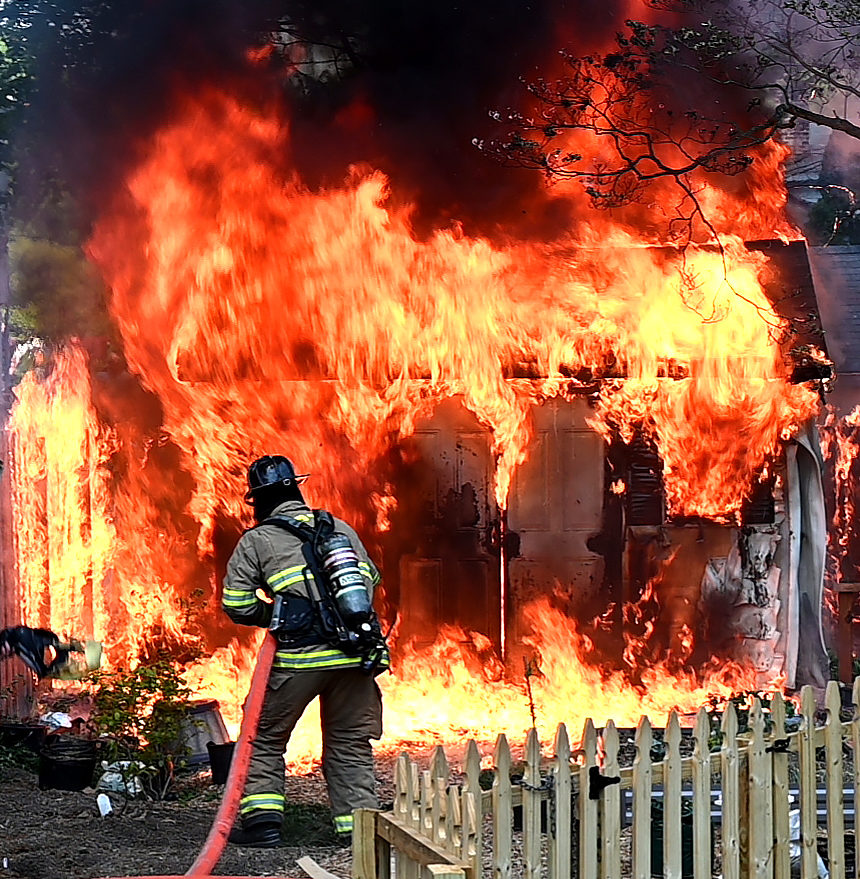
Jump back to the most basic fire scene. A one and a half story single family dwelling. We call that our bread-and-butter fire. There will probably be a few hundred of them in the USA today. Fire venting out 2 windows on the first floor. It’s 3 AM and you arrive before the first due engine company. I’ve probably been to hundreds of these in fifty ears. You have them in your first due area.
How many different ways do we have to attack the same fire?
The science is straight forward and simple. Until we apply an extinguishing agent at the correct rate of flow to combat the BTU energy output of the fire, the fire will not go out. That’s just plain math and science. We have learned about energy transfer, neutral planes, time/temperature curves, and watched the results in highly monitored test situations.
How we get there is where the art of command comes in. I guarantee you that every single reader has a different picture in their mind of the proper way to get to the same place on our example fire.
There are departments who will immediately stretch into the front door. There are departments who will go behind the fire and try and cut it off. There are departments who will not enter the interior under any circumstance. Yet it’s ame fire for all of them.
We’re going to discuss all of these, and hopefully gain some insight from each other. I welcome your thoughts, comments, suggestions and ideas.
Reach me at glenn@sellfiretrucks.com (No, I won’t try and sell you a truck that you don’t want)