Lessons in Firefighting: Insights from Captain George Geyer's Legacy
by Chief Glenn Usdin, former Chief, Lancaster Township, PA
George Geyer was my first Engine Company Captain. Though I was in the truck, the engine always went out the door first, and I got to run with the engine company very often. We can debate truck work versus engine work for the next 20 years. There is no better thrill than pushing down the hall with the nozzle and hitting fire until the room goes black and swampy. It just is the best.
By day George was a proud Local 3 union electrician in New York City, and by night and weekends he was our captain and husband to Dee and father to 6 great kids. His hands were as large as a baseball mitt, his shoulders and arms were huge and he could pick-up anything. He never raised his voice, he didn’t have to, he was just too huge to even think you could win an argument with him.
In the mid 1970’s, a particularly cold and very snowy winter, we got alerted to a house fire on South Bay Drive around 6:00 PM on a Sunday night. It was a bit of a run on the snow-covered streets, and we knew it was a working fire before we arrived. Right as expected, fire was showing out the kitchen windows and front door, a cooking fire that got out of hand and was rocking pretty good. 2 lines in the door, truck opened up and placed fans (not the PPV fans, but the huge electric Super Vac fans that took 2 men to move) to clear the smoke, a bunch of overhaul and then the fun job of packing wet 1 ½” hose through the snow and fire debris. George was always insistent; the rig never left the scene until it was all packed up. We swapped out dry house, rolled the wet hose on the back step and were almost ready to head back to the East End.
Suddenly the radio went live, the dispatcher called out, “630, 6314 and 636, you available for another call?” “Yes, both companies are available” “6314 and 636, report of a house fire on Arlyn Drive West off Merrick Road, receiving multiple calls” and we could hear the alarm phone ringing in the background. We knew it was a job. I can’t remember if we had the chains on, but I do remember that we had to go very slowly, from one end of our first due area to the other end.
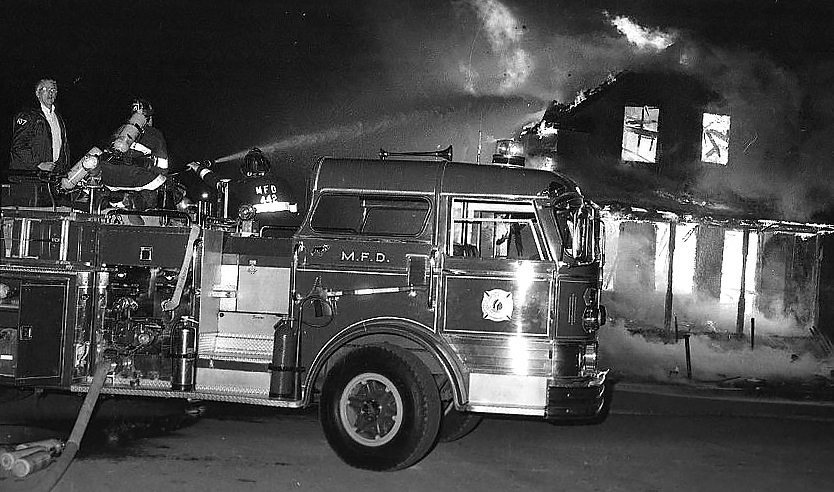
By now you’ve guessed that the place was rocking. Fire was belching out all the windows and doors of a one and a half story Cape Cod style home. The cops told us everyone was out and safe. The neighbors were all standing back and watching us. George got out of the officers’ seat of our Mack pumper, walked to the rear step, and calmly said, “I don’t want to see a single piece of 1.5” hose come off this pumper! Got it?” And with that pronouncement, three 2.5” lines were stretched and the fire was rather quickly out. We finally took one 1.5” line inside for mop-up, but there wasn’t much left, most of the roof was gone before we had water and parts of the second floor were hanging on by a few nails.
40 years later I’m Chief of Department here. A retired cop and his wife were asleep at 3:00 AM, a smoke detector woke the wife and she struggled to get her husband awake and down the stairs. By the time they barely got out the front door, the fire was right behind them. Our tones go off at 3AM for a dwelling fire in my neighborhood, less than 24 hours after a 30” blizzard has inundated the region. The wind was howling, temps were in the single digits, the roads barely passable.
I look out my bedroom window right onto the street where we are going, see nothing, get dressed and by the time I get the car started, the sky is now bright orange. It looked like sunrise except on the wrong horizon. I barely made it out of my driveway through the drift and in short order was confronted with a fully involved 2 story home. Neighbors told me the couple was safe across the street. I attempted a 360-degree walk-around and was soon in waist deep snow. I almost got stuck going back to the street.
There was a hydrant just past the home, the engine hooked up and the tower ladder was directly in front. They stretched a 5” line to feed the tower, put the bucket up and in service and the engine stretched one handline to protect exposures.
Within minutes our mutual aid companies began arriving, and their crews immediately reported to our engine and were positioning to take every handline they could off our pumper. At that very instance, the memory of George Geyer at the back of the pumper popped into my mind and I told the crews, “NO handlines, help stretch the supply to the tower and check the exposures!” I had to repeat it a few times, most of the crews couldn’t believe they were being STOPPED by a chief from stretching lines at a really big fire. I stood my ground. I’m sure it pissed off a few folks.
As we were at the back of the engine having this interaction, with absolutely no warning (except the knowledge that these buildings are basically made out of toothpicks), the entire house quietly and completely collapsed into a burning pile of rubbish. What had been a 2,000 square foot modern home was now a 15’ high pile of burning lumber. We all looked at each other in shock and the attempts to stretch the handlines were abandoned. The tower ladder got water and it took about 45 minutes to completely extinguish what was now a trash fire. In short order we released all of the mutual aid companies and had just 2 sections of 5” hose to pack up and bed the tower ladder and go home. It was one of the quickest major fire clean-ups we ever had.
I mentioned that I’ve spent 50 years of being a student of command operations. I’m fascinated with how Incident Command officers make decisions, both good and bad. Where do we get the knowledge to do this. Let’s face it, there just aren’t enough fires for most of us to get good each time.
A seminar with Chief Brunacini and the Phoenix Fire Department in the late 1990’s completely blew me away. Dr. Gary Klein made an eye-opening presentation on Recognition Primed Decisions Making and turned on a light bulb for me I’ve never turned off. Now I understood how we make command decisions.
“The RPD model identifies a reasonable reaction as the first one that is immediately considered. RPD combines two ways of developing a decision; the first is recognizing which course of action makes sense, and the second, evaluating the course of action through imagination to see if the actions resulting from that decision make sense. However, the difference of being experienced or inexperienced plays a major factor in the decision-making processes.”
What does this mean for us? Imagine you have a hard drive in your brain with the details of all of the fires you’ve been to. The more fires, the more data on the hard drive. With me so far?
When you arrive at a fire, your brain instantly searches the drive and tries to identify similar situations you’ve seen that match the one in front of you. THE MORE DATA YOU HAVE, THE EASIER IT MAKES YOUR BRAIN TO FIND A MATCH.
Dr. Klein studied a number of professions; firefighting, emergency medicine, military commanders, pilots, all folks who need to make very rapid decisions that have high consequences. Most aren’t faced with serious issues in the normal course of their duties. Pilots can fly an entire career and never have an engine explode. But the one time it happens, they better have that data file from training and research to immediately handle it. Military officers can have a 20-year career and never face live enemy fire. But one day, when least expected, your platoon can face an immediate threat and your crew expects you to act decisively. Your fire company can go to 1000 automatic alarms and outside rubbish fires, but the one day you get dispatched to the fire with entrapment, your brain better be ready to act, and act NOW!
My database of heavy fire condition dwelling fires in post blizzard conditions was developed 50 years ago by one crazy frigid night on Long Island with Captain George Geyer. Are you keeping your own personal database of the lessons learned from each fire you’ve been to?
Do a Google search for Recognition Primed Decision and you’ll pull up some excellent reading material. You can buy Dr. Klein’s book “SOURCES OF POWER” on Amazon. YouTube is loaded with fire videos, look for the ones that are pre-arrival and study them closely and take out the lessons from each fire you see. They’ll fill your personal drive with tons of data.
Be safe.